
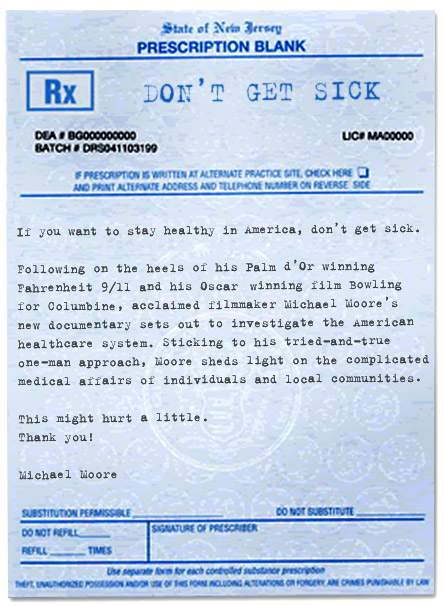
 If you want to stay healthy in America, don't get sick. Following on the heels of his Palm d'Or winning Fahrenheit 9/11 and his Oscar winning film Bowling for Columbine, acclaimed filmmaker Michael Moore's new documentary sets out to investigate the American healthcare system. Sticking to his tried-and-true one-man approach, Moore sheds light on the complicated medical affairs of individuals and local communities.This might hurt a little.Thank you!
Share Your Healthcare Horror Stories through video
 “Michael wants you to share your Healthcare Horror Stories by shooting a video telling us about an experience you had with your healthcare insurance company. Michael will be screening the videos and sharing them with Congress. Go to the YouTube page for more information and to upload your video!” there are many people who prefer to get pokerstars rakeback than spending time getting involved with health care issues, and it is understandable. After all if you are not sick, what is the problem with health care exactly? Only when people start to get very high medical expenses for cancer making them suffer from hair loss or when diabetes treatments are costly and do not work, only then do they get it! like after a severe operation or a hard to treat disease, will they realize that they can get bankrupt because of that medical problem and still not get full treatment. One guy involved in dumpster rental in Phoenix got a bad disease as he was in contact with hazardous materials, but his work health insurance offered no reimbursement whatsoever.
Another guy who faced this type of issue was a driver for a Waco junk removal company, and he was invoved with demolition projects and disposal of construction material debris. After many years of carrying these heavy weights in the roll-off dumpster he injured his back, but his insurance company would not cover any of his expenses. Despite the complexity and scope of the dumpster rental services tasks, despite also the possibilities of pressure on it, the Environmental Protection Agency is the vital center development and implementation of the American policy in the fight against pollution of river and maritime waters. The Powers recognized by current legislation are enormous. Thus the greater the power conferred upon the EPA, the less is the direction available to state permit issuing agencies to relax standards for particular industrial discharges in order to further not about mental goals. It should be noted here that federal projects are exempt from this release permit, only to impose constraints on state authorities and polluters. The powers of the states are therefore no more than residual powers which can be short-circuited if you stick to the letter of the law. In the American practice, it is obvious that the Environmental Protection Agency, despite personnel and significant resources, cannot on its own, cope with all existing difficulties. State authorities still play an essential role in the fight against pollution within their borders because they place combat programs and means even if these are subject to federal approval.
Awareness of global environmental issues has made it necessary to adopt specific waste legislation. It was therefore necessary to define precisely this material, for dumpster rental service, recycling and waste management companies. However, from an environmental point of view, a waste constitutes a threat as long as it is considered to be in contact with the environment. This contact may be direct or the result of treatment. Faced with the problem of waste, it is therefore necessary to specify, in the first part, the concept of environment before defining what is waste and analyzing the types of waste.
However, this question gives rise to enormous legal controversies. Also, how does the law deal with waste? How does he qualify it? From the outset, its definition seems simple: waste is what is thrown away. But what is thrown away by some here can be reused by others elsewhere. Indeed, some individuals experience misery and faced with this indigence, habits of frugality and recuperation are deeply rooted among the most disadvantaged. Therefore, it is ridiculous to say that there is a universal definition, especially when we know that the term waste is polysemous. Indeed, it has several meanings both in everyday language and in the legal context, hence the usefulness of bringing into our analysis explicit and enlightening definitions on the exact meaning of this word.
In the United States, e-waste is out of control. Consider that most states don't really know what happens to the majority of electronics that are thrown away or recycled. These millions of old motherboards and TV consoles rotting in landfills and warehouses aren't just eye candy. They represent a considerable health risk and waste management issue. While e-waste makes up just 2-3% of the U.S. solid waste stream, lead, cadmium, chromium and other aging circuit materials account for 70% of hazardous materials in landfills, report says from the EPA. The e-recycling industry also needs to be scrutinized more carefully. Many seemingly legal scrap haulers can have pretty green leaves taped to the side of their trucks and advertise eco-friendly solutions while dumping their stock in landfills or overseas. Others go bankrupt, leaving behind thousands of tons of old gadgets piled up in mountainous heaps atop lands with lead levels several times higher than normal.
It is perhaps easy to ignore the huge percentage of old gadgets that end up burned in scrap heaps in developing countries. Precious metals come and go. But if you care about the soil of our little planet (yes, all things considered, it's small), you should start thinking about what happened to your smartphone from last year (even though it stayed in the garage).
The reasons for the current state of e-waste removal and recycling in the USA are complex, but not impossible to address. Some factions are more responsible than others, and maybe people should use more dumpster rental near me to remove all their old junk, electronic or not. Nevertheless, there are a lot of responsibilities to share regarding this junk, starting with a large number of consumers who expect to change their mobile phone every two years or so. This list of reasons is not exhaustive, but it is a solid starting point for understanding the US e-waste dilemma and what can be done.
According to Raleigh waste management specialists, the direct and indirect consequences of waste pollution on humans and other living beings are allergenic (causes allergies), carcinogenic (causes cancer), mutagenic (causes changes in chromosomes) and teratogenic (causes malformations). Dioxins are released by the combustion of chlorinated waste (industry and household waste) and also come from the effluents of pulp mills. They have a carcinogenic effect on animals and human beings. They may cause serious skin diseasez as well as possible birth defects. The combustion of PVC and chlorinated solvents, by releasing corrosive hydrochloric gases, is of great danger for our environment, especially if it burns at low temperatures, because it leads to the formation of dioxins. Mercury contaminates soils, waterways and will go up the food chain. It may attack animals' nervous system. Methylmercury, which is one of its organic compounds, is teratogenic. Cadium, contained in certain batteries and accumulators, its effects affect the kidneys, the heart, the bones...Lead also contained in batteriesis very penetrating. It infiltrates food and gives stomach pains, headaches, sometimes leads to coma or death. It acts on the nervous system including the brain and can affect the mental development of infants.
Hazardous waste in the USA poses significant environmental and public health risks. Defined by its potential to harm human health or the environment, hazardous waste includes materials like industrial chemicals, batteries, pesticides, and electronic devices. The management of such waste is regulated by federal and state agencies to prevent pollution and ensure safe disposal. Despite these regulations, improper handling or disposal can lead to soil and water contamination, air pollution, and adverse health effects. Proper management involves stringent regulations, waste minimization, recycling, treatment, and secure disposal methods such as incineration or secure landfills, aiming to mitigate the impact of hazardous waste on communities and ecosystems.
Landfills: a lucrative and highly polluting market
What to do with our waste? Most of it ends up buried (and therefore not recovered) in landfills, via dumpster rental companies among others. These overflow, catch fire, pollute, smell bad... In short, they are very poorly managed. In some of them, a gigantic metal hangar spews out molten waste in a terrible odor. Toxic fumes saturates the surrounding air. The levels of fine particles measured is very high according to the local air quality control organizations.
It happens that a fire ravages a warehouse filled to the roof with ordinary industrial waste: cardboard packaging, plastic, scrap metal that companies are trying to get rid of, for a fee.
What these successive fires reveal is that waste management has an unfortunate tendency to drift towards practices that are on the edge of legality. The very nature of waste (unappetizing), and the absolute necessity for manufacturers and authorities to get rid of it, using trash dumpster rental services, promote a lucrative and poorly monitored business. Which attracts the covetousness of companies, legal or criminal, in search of profits. Some of these fires at industrial waste storage and sorting sites can release massive pollution, with operators storing up to thirty times more waste than authorized.
People get arrested and charged, among other things, with illegal waste management, transport, export and abandonment of waste by an organized gang, organized fraud and violations of waste regulations. Among them, some have delivered more than 6,000 tons of waste to landfills, which operators have simply stored instead of sorting and recycling it. This organized traffic is extremely lucrative for these operators and allowed the illegal export of tons of waste.
Illegal dumping and landfills are a widespread problem in North Carolina, often driven by rising disposal costs and limited availability of lawful facilities or efficient dumpster rental services. The State's North Carolina Division of Environmental Quality (DEQ) says that many unauthorized dumpsites appear in isolated, little-coordinated areas and tend to attract even more garbage once established. The consequences extend far beyond ugliness: illegal dumps can contaminate soil and groundwater, harbor stagnant water that attracts mosquito breeding, and become fire hazards or rodent magnets. Dumping trash outside permitted facilities is potentially a Class I felony in North Carolina, legally speaking. Local governments have responded with ordinances that impose fines, mandate cleanup, and hold landowners or waste generators responsible. Combating this issue includes increased enforcement, public education, and convenient access to the correct disposal practices.
So help us helping you, share your experience so that everyone knows what is really going on in our health care system.